

It might have been my third week here in Brighton when I was walking down London Road and decided to stop for a bite to eat at some cosy homemade (looking) pie restaurant. The woman who took my order, also an African, remarked: ‘You are from South Africa, aren’t you?’. Pleasantly surprised I asked her, ‘How did you know? Are you also from South Africa?’. ‘No – I’m from Ghana’, she replied. ‘It was your butt. You have a wide butt. All you South African women have such wide butts’, she added. I wasn’t at all offended, just a tad bit amazed to learn that I was dragging my national identity behind me all along… Uhmm, or maybe I should just lay off those pies.
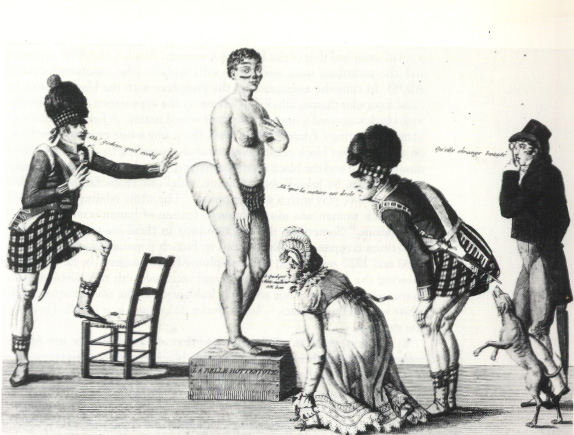
After some thought, I figured that it really shouldn’t have come as that of a surprise, considering that I carry my colonial history on my butt too. Saartjie Baartman (before 1790 – 29 December 1815), was a Khoisan woman who was shipped away from her home in Cape Town (South Africa) to be exhibited as freak show across Europe. She was paraded under the dysphemism ‘Hottentot Venus’[1]. Baartman’s body was used to set a borderline between the ‘abnormal’ African woman and ‘normal’ white woman. Her ‘protruding buttocks and an extended labia minora made society view her as this ‘ “wild or savage female” ’ (Wikipedia: Saartjie Baartman).
Intersectionality of post-colonial feminism
I sometimes struggle with the limited view of intersectionality that Black feminists tend to take. Strange considering that intersectionality was the basis of post-colonial feminism (Crenshaw 1991). Post-colonial feminists were concerned with the impact of racism and colonialism on so-called ‘third world women’ (Collins 1991). They also challenged our misrepresentation by western feminism, which often portrayed non-white women as childlike victims who needed to be rescued (Mohanty 1991). Scholars such as Kimberlé Crenshaw (1991), Patricia Hill Collins (1991) and Chandra Mohanty (1991) brought us this understanding.
However, when colonisation is addressed within the intersectionality discourse it is often to (re)address the legacy of racial oppression (Crenshaw 1991). But what about the sexual colonial legacy I carry on my butt? I am not talking about gender per se. I’m referring here to the sexual innuendos that were attached to Baartman’s bottom, and which I am forced to drag around behind me through my existence. What is worst is when my fellow feminists reprimand me for this position.
Take for example me twerking on the dance floor to reggae music. Some feminists might view this as a form of degradation. Or when Beyoncé Knowles collaborates with Nigerian feminist writer Chimamanda Ngozi Adichie to produce Flawless:
http://vimeo.com/91569178
As much as I appreciate bell hooks for having introduced me to Black feminism through her work Aint I a Woman: Black Women and Feminism (1981), I find it rather extreme that she would refer to Beyoncé as a ‘terrorist to young Black women’s minds’.
For one, when I see Beyoncé I see a Black, artistic, successful career woman, who is a wife, mother, and still manages to look sexy. Well, I don’t know about you, but for this young Black woman that sure is inspiring. Secondly, when I see Beyoncé being ‘bootylicious ’ in her music videos, I look at my curves in the mirror and think ‘hmmm, maybe I too can put on a bikini and take a walk along the beach’. If you have not been blessed with a well-endowed bottom, I’m not sure you can appreciate how sexually liberating that is. And thirdly, quite honestly now – I don’t think the issue should be whether Beyoncé actually did ‘wake up like this’ (supposedly without make-up, which we all know she did not), but the actual message of being ‘flawless’. The fact that I am complete in my beauty (curves and all). That I am enough. Isn’t that what feminism tries to teach us?
Hillary Crosley offers an explanation on her blog post on What bell hooks Really Means When She Calls Beyoncé a ‘Terrorist’, ‘Age is a factor. Older feminists don’t always see feminism in the same way as the generations after them — that’s why we have the “waves.” [original hyperlink]. So where you and I might see Beyoncé controlling her sexualized image and turning it on its ear in videos like “Pretty Hurts” or claiming ownership of her body, hooks and my own mother would probably just think she fell victim to The Man’s idea of “being sexy” and she’s degrading her body to slang records. Not a lot of room for nuance[2] there.’
I suppose when you consider that hooks and the other abovementioned post-colonial feminists primarily fought against racism and for access to gender and civil rights, it is not surprising that it might be difficult for some of them to fully appreciate that today’s feminism struggle also involves access to sexual rights, and to a great degree that entails being able to sexually liberate the body. It is this dimension of feminism’s intersectionalities that I speak to; the intersectionality of sexuality.
Intersectionality of sexuality
Here I am not just referring to sexuality in itself, but it’s manifestation through my body (the wide butt), intersecting with my colonial history (daughter of Baartman), my nationality as a Black South African woman, my religious affiliation to Rastafarism (hence the reggae), and my cultural identity (as a Zulu). I constantly live with these intersecting social dimensions (Yuval-Davis 2006), and negotiate my existence through them on a daily basis (as the pie restaurant incident clearly illustrates). But wait – these are not necessarily oppressive, all the time. Check out this video of a Tinyungubyiseni va-Tsonga Culture Event filmed in 2011:
And here you thought twerking came with Nicki Minaj’s butt implants. Well, it turns out that the Shangaan women have been mastering the skill for centuries now. There is even a xibelani/shibhelani (multi-layered skirt) to help accentuate the waist and butt movements. Yes – we African women have been celebrating our wide hips and butts long before the coloniser came and made us feel ashamed of them.
Yet even way past colonisation I am still made to feel shameful when I dance with my butt. I am told I am demeaning my body and playing to the ‘male gaze’. Well guess what – when I twerk, I am liberating myself from the colonial chains that denigrated Baartman for having a large butt. When I twerk, I am reaffirming and celebrating my national identity as a South African woman who shares cultural (needless to say physical) traits with the Khoisan and the Shangaan women. When I twerk to reggae music I am embracing my religious identity as a Rasta woman. And finally, when I twerk, I am reclaiming my positive sexual power (believe it or not), which you insist on seeing as oppressive. As incongruent as these social dimensions may appear to be, the fact remains that they inform my existence.
So next time you disapproving stare at me across the dance floor with that ‘Othering’ ‘Western gaze’ (Mohanty 1991) – my fellow feminist – don’t feel ashamed for me, because I am a bootylicious feminist! Watch me twerk!
Endnotes:
[Title] A play on Helen’s Reddy’s ‘I Am Woman (Hear Me Roar)’ song from 1975. When the United Nations declared that year International Women’s Year this song was chosen as the theme (video link reference: https://www.youtube.com/watch?v=MUBnxqEVKlk).
[1] ‘Hottentot’ as the then-current name for the Khoisan, which is now considered offensive. ‘Venus’ in reference to the Roman goddess of love.
[2] Please note that the title of this blog is ‘Nuances of Sex, Gender and Development’, because it is the ‘nuances’ of these elements that I am interested in exploring.
References:
Collins, PH (1991) Black Feminist Thought, London: Routledge Crenshaw, K (1991) ‘Mapping the Margins: Intersectionality, Identity Politics, and Violence against Women of Color’ in Standford Law Review 43(6) pp1241-1299.
hooks, b (1981) Ain’t I A Woman? Black Women and Feminism, New York: South End Press.
Mohany, CT (1991) ‘Under Western Eyes: feminist scholarship and colonial discourses’ in Mohanty, CT, Russo, A and Torres, L (eds.) Third World women and the politics of feminism. Bloomington, IN: Indiana University Press, pp. 51-80.
Yuval-Davis, N (2006) ‘Intersectionality and feminist politics’, European Journal of Women’s Studies, 13(3), pp. 193-209.