

Yingwana, N. (2022). Feminist Participatory Action Research in African Sex Work Studies. In A. Bezuidenhout, S. Mnwana & K. Von Holdt. (Eds.) Critical Engagement with Public Sociology: A Perspective from the Global South, pp. 144–170. Bristol University Press. ISBN: 978-1529221145.
‘Critical Engagement with Public Sociology: A Perspective from the Global South’ book cover. 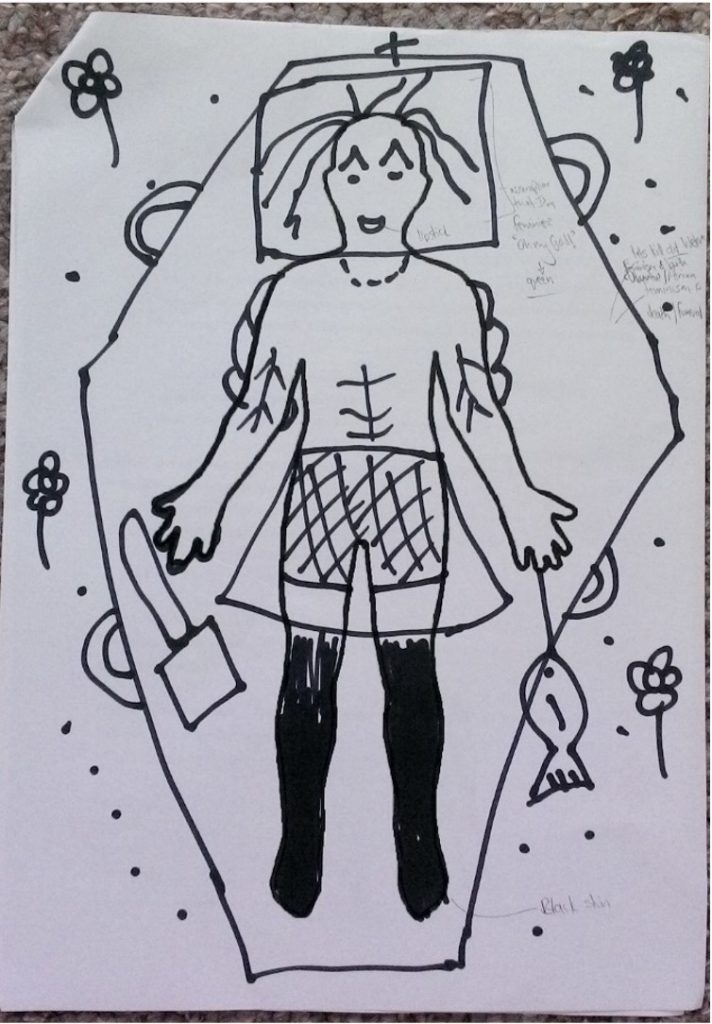
Source: FPAR Workshop, used with Daniel’s (pseudonym) permission. Pencil notes read: Line pointing to the mouth: “lipstick”. Boxed arrow around the head: “assumption that I’m feminine ‘Oh my God!’ queen”. First line pointing to the coffi n: “lets kill old Western Feminism & birth ‘Ubuntu’ African”. Second line from the coffi n: “Feminism is death/ funeral”. Line from the feet – “Black skin”.
Introduction
What does it mean to be an African sex worker feminist? In answering this question, two qualitative studies were conducted with African sex worker groups in 2014 and 2015; the South African movement of sex workers, known as Sisonke, and the African Sex Workers Alliance (ASWA). Based on their embodied lived experiences, each participant described what it meant to be an African, a sex worker and a feminist, and then collectively discussed these in relation to each other and the social dimensions they occupy.
Both studies concur that even though these three identities may appear incongruent, in certain embodiments, they actually inform each other. The purpose of the studies was to allow African sex workers to conceptualize for themselves what feminism means, as it relates to their continental identity. The main objective of this work was to encourage so-called ‘mainstream feminists’ and sex worker rights feminists to start recognizing each other as comrades in the struggle for gender and sexual liberation, thus strengthening solidarity for sex worker rights activism across social justice movements; especially as some feminists still find it difficult to recognize selling sex as a legitimate form of labour.
To this end, a Feminist Participatory Action Research (FPAR) methodology was employed. Colleen Reid and Claudia Gillberg describe FPAR as a ‘participatory and action-oriented approach to research that centres gender and women’s experiences both theoretically and practically’ (2014: 343). FPAR draws from feminist principles of knowledge production. It also prioritizes the research participants’ active engagement in the meaning-making process and requires that the study output be used to advance a social justice agenda or some form of ‘good change’
(Chambers, 1997 ).
Generally, I understand FPAR to be a methodology that can be employed in any academic discipline. The distinguishing factor that makes it most appealing when working with stigmatized communities is that while other methodologies may indirectly contribute towards some positive change, in the FPAR approach, by its very design, social justice is explicitly the intended output (or action) of the study. Therefore, methodologically, FPAR is intrinsically a social justice inquiry, no matter what the discipline. Like Kathy Charmaz (2011 : 359), ‘[w] hen I speak of social justice inquiry, I mean studies that attend to inequalities and equality, barriers and access, poverty and privilege, individual rights and the collective good, and their implications for suffering’. Hence, a social justice inquiry also entails critically engaging with structures of power and how those systems shape human lives (Charmaz, 2011 ).
While reflecting on both studies, this chapter focuses largely on the FPAR methods employed in the second study with the ASWA feminists in order to illustrate how this methodology can be used to unpack the embodied lived experiences of African sex worker feminists and help support sex worker rights activism in the continent.