
Looking back at this term of ‘Theoretical Perspectives in Gender and Development’ lectures/seminars I find it hard to pin down one major learning. One thing for sure though – I now see the world a little bit differently to when we started the module back in September. To illustrate what I mean by this I’ll discuss the group presentation Jessica Buhl-Nielsen, Naoko Ono and I delivered to the class last Friday on ‘Where now for Gender and Development’. Looking at the recent scourge of women wearing mini-skirts being stripped naked by mobs of men in Kenya as a case study, our group explored how social media campaigns were used to mobilise action, and what this means for the future of Gender and Development.
[slideshare id=42599253&w=476&h=400&sc=no]
On the 10th of November cell-phone footage of a woman wearing a red top and a black mini-skirt being stripped went viral on online media. The film showed a mob of men ripping her clothes off her body, supposedly as a reprimand for ‘tempting them’ with her choice of clothing. The incident, apparently not it’s first and since then seeing a series of nearly daily copycats, took place at a matatu (mini-bus) terminal in Nairobi (Kenya). When I first came across the video on a friend’s Facebook page I could not finish watching the two minutes of footage. So please be warned that this footage is disturbing to sensitive viewers (such as me).
[youtube https://www.youtube.com/watch?v=1y7cpS5DYu0&w=420&h=315]
For my section of the group presentation I focused on the #MyDressMyChoice Twitter campaign and the global outrage and local action it sparked. Interestingly, the campaign was initiated by a popular Facebook group made up of Kenyan mothers who used the platform to ‘exchange information about childcare and parenting (Gregory Warner, NPR News).
Unpaid care work
This reminded me of Deepta Chopra’s lecture on ‘The “Careless” Economy’[1] in which she stressed that most unpaid care work just cannot be measured in monetary terms, but that does not make it valueless. Indeed, she argued that most unpaid care work is socially invaluable. This is clearly illustrated by these Kenyan mothers who allowed their care work to evolve into activism.
So even though care obligations often ‘create obstacles to women’s full and meaningful participation in the public sphere’, it appears that online social media such as Twitter and Facebook are allowing caregivers to engage with the politics of the public sphere from the comfort of their homes (the private sphere) (Esplen 2009: 1).
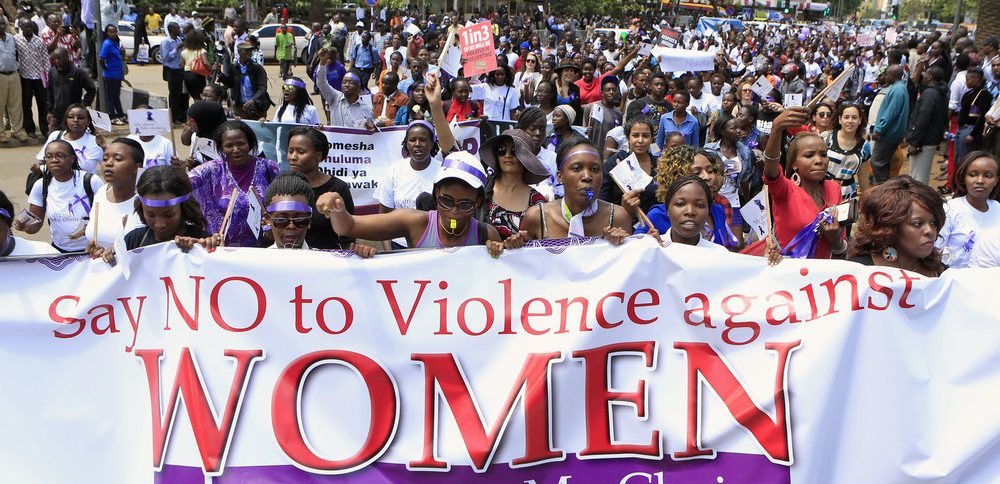
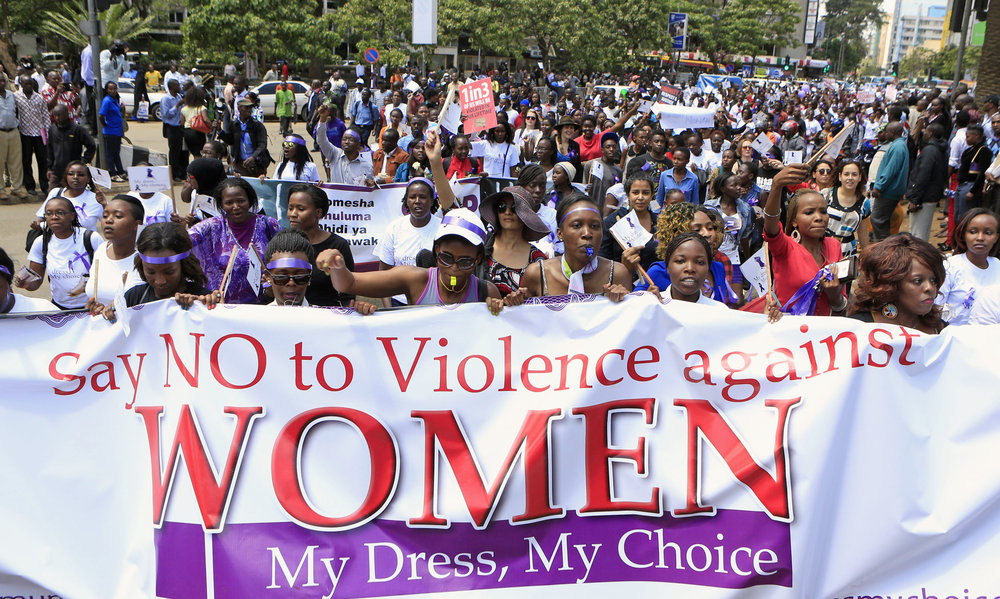
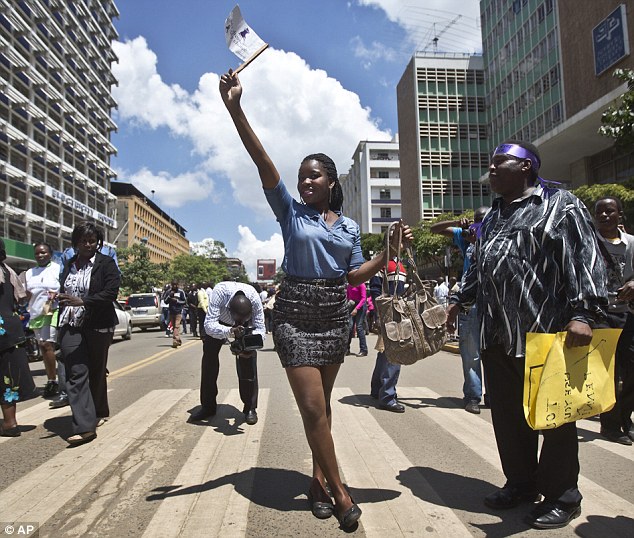
About a week after the attack nearly a thousand Kenyan activists marched in protest against the policing of women’s bodies, and called on the government to act. Some wore mini-skirts to drive the message home.
Battle for masculinities
Raewyn Connell and James Messerschmidt argue that hegemonic masculinity as a concept shouldn’t be simply reduced to cultural control, but understood as a continuous struggle for dominance, and that ‘subordinated masculinities [can] influence dominant forms’ (2005: 829). Again, we find this exemplified in this case study by the traditional/cultural masculinities challenging the so-called non-African/Western masculinities. Twenty-six year old student James Macharia told MailOnline that ‘an African woman should be decent’ and cover her body; otherwise she is seducing men (reference). Therefore, the stripped victims were asking for it.
With the mounting global pressure Kenya’s Deputy President William Ruto has come out in strong condemnation of the assault and (perhaps to save face) has instructed Inspector General Police David Kimaiyo to prioritise this case. However, according to Kimaiyo police cannot proceed with the investigation unless the victim comes forward. In this instance, these government officials could be said to be displaying de jure masculinities, which seek to uphold the Western ideals of justice and human rights.
Non-conforming masculinities such as the male protestors who wore short dresses in solidarity with the women were called ‘gay’ by fellow male-onlookers and intimidated for taking part in the march. By calling their ‘manhood’ into question, non-conforming masculinities are kept in-line through the threat of violence.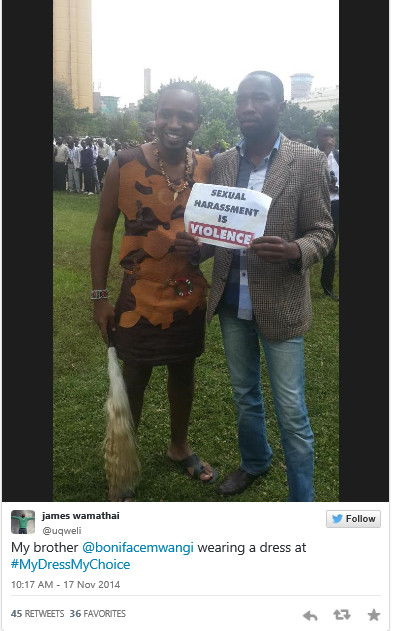
‘Choice’ to culture vs. ‘choice’ to human rights
The reasoning posed by the men that strip women in mini-skirts is that an African woman should cover her body out of cultural respect. This reminded me of Jane Cowan’s lecture/seminar on ‘Engaging with “culture”, traditions and rights’[2] where she argued that women are often seen as carriers of ‘cultural markers’ through their bodies, hair and dress. Indeed, for these traditional men a mini-skirt on a Kenyan woman is considered a desecration of African culture. In policing her choice of dress, they feel they are upholding African cultural values. However, when you consider that most African cultural dress initially entailed women being bare-breasted, it is difficult to comprehend what ‘African culture’ they are actually protecting. This tells us that perhaps the stripping of women in mini-skirts has little to do with upholding African cultural values, but rather maintaining patriarchal power relations.
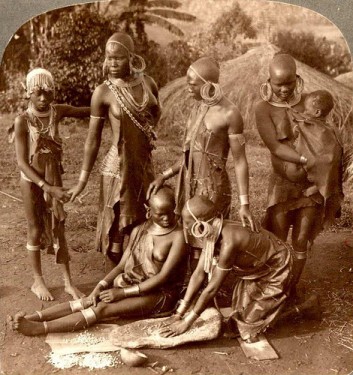
- Traditional young Kikuyu women in 1910. Source: www.exposingblacktruth.org
What is also interesting to note is the use of the word ‘choice’ in the #MyDressMyChoice campaign, and the counter campaign #NudityNotMyChoice (which is in support of the stripping of women in mini-skirts). According to Sally Merry the international human rights discourse is based on an individualistic ‘neoliberal privileging of choice’ rather than cultural and/or religious community-based conceptions of justice (2006: 103). This points to a ‘disjuncture between global human rights law and local justice’ (Merry 2006).
Policing of women’s sexualities
Finally, we come to the actual policing of women’s sexualities. When all is said and done, the subjugation of women’s sexualities lies in seeking to maintain heteronormativity, which is the basis of patriarchy (Katz 1990). By punishing women who overtly ‘perform’ (Butler 1993) their sexualities, and by threatening non-conforming male protestors who wore dresses in solidarity, dominant masculinities are able to maintain their cultural patriarchal control.
According to Cornwall et al, if we are to effectively address the policing of gender we need to start making ‘linkages between sexuality, human rights and development’ (2008: 1). They argue that we should be just as ‘concerned with how the body is clothed, from women feeling forced to cover their bodies to avoid unwanted sexual attention… [to] what people do when their clothes are off’ (Cornwall et al. 2008: 5-6). They add that this could well determine not only one’s ability to enjoy sexual relations, but also the ‘very right to exist’ (Cornwall et al. 2008: 6).
Final reflections
So you see, I have not just learned gender and development theories in this module, but how to apply these theories in my comprehension of the world around me. It has greatly improved my analytical abilities. Before I would have just been angered at the stripping of women, but now I can unpack its elements. As development scholars, understanding the context and its nuances helps us design interventions that have a higher likelihood of succeeding. This is what I take away from this module.
Join the ‘Take action NOW!’ campaign
Take a couple of minutes to sign this ‘Kenya: Stop the Violent Attacks on Women – #MyDressMyChoice’ letter calling for the Kenyan government to Stop the Violent Attacks on Women.
References and footnotes
Butler, J. (1993) Bodies that Matter: On the Discursive Limits of ‘Sex’. New York: Routledge.
Connell, R. W. and Messerschmidt, J. W. (2005) ‘Hegemonic Masculinity: Rethinking the Concept’. Gender and Society, Vol. 19, No. 6. Sage Publications.
Cornwall, A., Correa, S. and Jolly, S. (2008) ‘Development with a body: making the connections between sexuality, human rights and development’. Development with a body: sexuality, human rights and development. London: Zed Books.
Esplen, E. (2009) ‘Gender and care: overview report’, BRIDGE reports. Brighton: IDS.
Katz, J. (1990) ‘The invention of heterosexuality’, Socialist Review, Vol. 20, No.1.
Merry, S. E. (2006) ‘Disjunctures between global law and local justice’, in Merry, S. E. (ed.) Human rights and gender violence: translating international law into local justice. Chicago: Chicago University Press.
[1] ‘Theoretical Perspectives in Gender and Development’ lecture/seminar on ‘The “Careless” Economy’ at the Institute of Development Studies (IDS), on 20 November 2014.
[2] ‘Theoretical Perspectives in Gender and Development’ lecture/seminar on ‘Engaging with “culture”, traditions and rights’ at the Institute of Development Studies (IDS), on 7 November 2014.